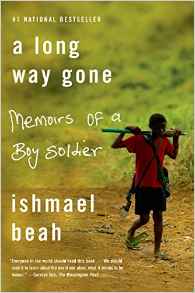
 In A LONG WAY GONE, Ishmael Beah provides a devastating memoir of his experiences as a child soldier in Sierra Leone’s civil war during the 1990s.
At the age of 12, his village is attacked by rebels (the RUF), separating him from his family and forcing him to wander the countryside trying to stay alive. Eventually he is forced to join an Army unit who trains him to fight and gives him drugs to bolster is courage. As a child soldier, he fights the rebels and sometimes raids civilian villages to gather supplies so his unit can keep going. After four years, UNICEF was able to get him removed from his unit and put into a rehabilitation program, where he was adopted by his uncle. After the war reached the capital of Freetown, where he lived, he fled the country and ended up in New York, where he was adopted by a a UNICEF worker.
Beah tells his story in a very simple, direct way. Often, as you’re reading, you can hear the words as a child would say them. The brutality of the civil war is horrible–drug-crazed rebels and soldiers fighting, looting, raping, terrorizing the country. The story is an amazing journey of survival and a lost childhood.
If you’re interested in this subject, you might also check out BEASTS OF NO NATION, a Netflix movie starring Idris Elba, which was a fantastic portrayal of child soldiers, based on the 2005 novel of the same name by Nigerian author Uzodinma Iweala.
 They found out he was the eldest son of Gregorio Cellini of Venice and offered him endless credit, selling him new powder and shot for his matchlock gun at a grossly inflated price. Taddeo bought himself a leather jerkin to wear over his doublet and Prospero a new feathered hat. It was a tradition, they said, for a newcomer to issue a challenge to shoot at targets, and the loser had to buy drinks all around for the platoon. Taddeo, considering himself a good shot and eager to please his new friends, agreed. The men laughed, rushed into a tent, and dragged out a skinny boy named Félix, who arrived sporting a lazy eye and a bucktoothed grin.
 Happy to announce that at long last, THE ALCHEMISTS is available for pre-order for Amazon Kindle and Kindle Unlimited eBook!
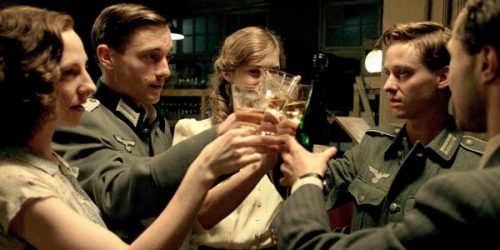 The story begins in mid-1941. Germany is triumphant in Poland, France and the low countries, and has declared war on the Soviet Union. In Berlin, five friends gather afterhours at a pub to see each other off: Wilhelm Winter, a lieutenant in the infantry bound for Russia; Friedhelm Winter, his younger brother serving in the same platoon; Greta, who has aspirations for fame; Charlotte, an army nurse; and Viktor Goldstein, a Jewish tailor who is Greta’s boyfriend.
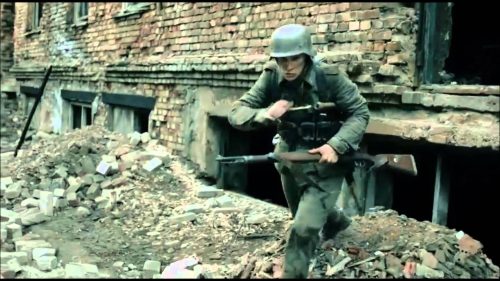 I have a confession to make, which is I typically don’t like war movies with women in them, as the female roles often seem grafted on to create a gratuitous love story. In GENERATION WAR, the male and female characters add to the story equally. Greta must navigate the secret police to save her Jewish boyfriend. Charlotte must deal with both the war and her belief in the Reich. The women face no-win ethical choices that are as severe as the men’s, and the results are compelling and dramatic, showing a well-rounded story of these young Germans.
  As for the German characters as a whole, they are also presented as very realistic in an unflinching contemporary view. Wilhelm and Charlotte, in particular, believe Hitler knows what he’s doing, occasionally repeat the slogans they’ve been taught, and overall have faith in the Reich and the Army, which makes their demoralization in the face of reality all the more dramatic. Greta is interesting because one senses she sees it all as a farce but plays along to get what she wants. Friedhelm is the lone objector but over time survival takes precedence over his moral qualms, and like everyone else, he becomes dehumanized by everything around him.
 THE YEAR OF LIVING DANGEROUSLY by Christopher J. Koch (1978) is a sophisticated story about post-colonial Indonesia, journalism and the driving force of identity, particularly the destructive force of conflicting identities.