Author of adventure/thriller and horror fiction

  • Home
  • The Blog
  • Email List/Contact
  • Interviews
  • Apocalyptic
  • Horror
  • Military Thriller
  • Sci-fi/Fantasy
  • All books

The Spanish Flu Pandemic of 1918-19

November 6, 2017 by Craig DiLouie Leave a Comment

flu

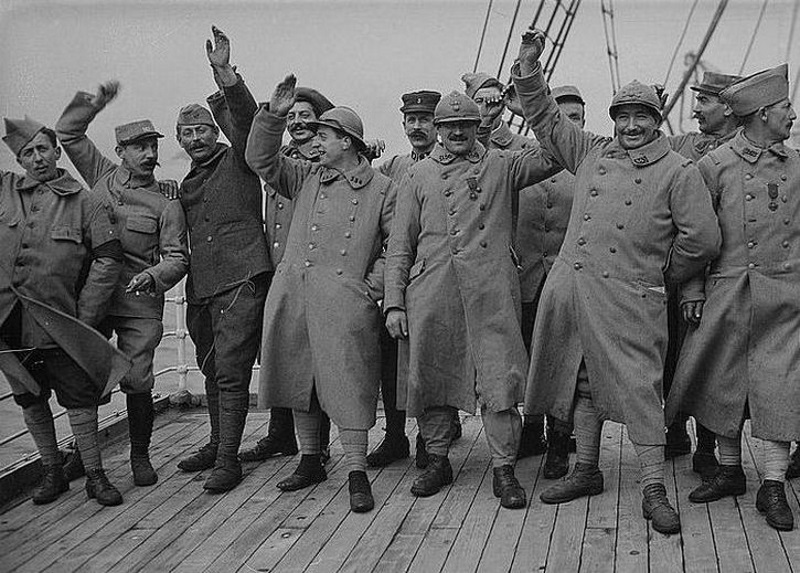
In 1918-19, the Spanish Flu burned its way through the world’s population of two billion in less than two years, killing more people than died in combat among the 19 nations involved in five years of fighting during World War I.

As World War I was ending, an even bigger threat loomed—the Spanish Flu, which followed in the wake of mass troop movements during the war, and ravaged the armies on both sides of the trenches. In fact, the Spanish Flu may have played a decisive role in ending the conflict; it is believed that the flu dramatically weakened the German Army and caused its last great western offensive to fail in 1918, bringing the war to a close.

In the spring of 1918, Spain, a neutral power, did not have wartime censorship and so was the first to report the epidemic that subsequently became known as the Spanish Flu, the Indian Flu, the Naples Soldier and other names around the world. The flu, however, was thought to originate in Canton, China, although the first recorded cases occurred at a U.S. Army base in Kansas. At first, the flu seemed mild, although millions caught it, eight million in Spain alone, including King Alphonso XIII.

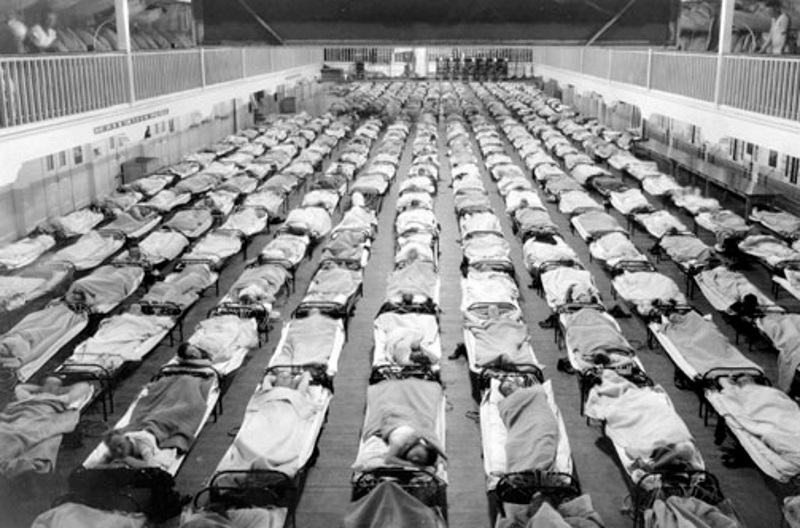
As summer turned to fall, it turned deadly. The flu burned its way through every continent except Antarctica. Doctors were helpless against the scourge. Public authorities shut down public places such as churches and theaters. Some even passed laws against sneezing in public. People wore gauze masks in public. Wherever the flu struck, people displayed the best and worst of human nature—courage, charity, fear and prejudice.

In October, the epidemic peaked in the U.S. and Canada. Thousands were dying every day. Then the number of cases declined until the Spanish Flu disappeared the following July.

Some 22 million Americans got sick and more than 675,000 died out of a population of 103.2 million. As a result of the Spanish Flu, the average life expectancy of Americans dropped by 10-13 years. Globally, the Spanish Flu killed 40 to 100 million people, or up to five percent of the world’s population of two billion. About one billion caught it. Based on today’s population, this is the equivalent of more than three billion people catching it and 130 to 320 million people dying.
flu2

Filed Under: Apocalyptic, Other History, The Blog

Americans Fight on Russian Soil in 1918-19

November 4, 2017 by Craig DiLouie Leave a Comment

america

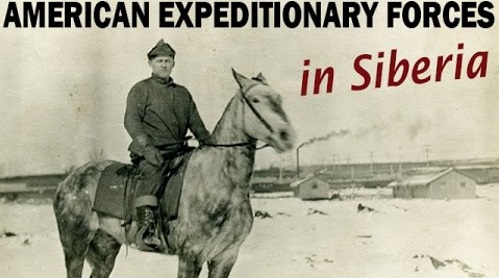
Let me tell you about the time the U.S. Army fought the Red Army on two fronts on Russian soil. That’s right, from September 1918 to July 1919, nearly 13,000 American troops fought in Russia as part of an international invention in the Russian Civil War that had started immediately following the 1917 revolution.

The Russian Civil War had two major contestants, the Red Army (Bolshevik socialists) and the White Army (monarchists, capitalists, alternative socialists, democratic and undemocratic). Additionally, the Green armies (rival socialists and non-ideological) fought both the Reds and the Whites.

Fearing Bolshevik socialism, eight countries intervened to prevent the Reds from consolidating power. The British and French had three objectives. First, prevent the capture of Allied war materiel in Arkhangelsk. Second, help the Czech Legion stranded on the Trans-Siberian Railway. Third, get Russia back in the war and reopen the Eastern Front. They asked the Americans for help, and President Woodrow Wilson agreed, overriding objections from his War Department.

The U.S. sent 5,000 troops to Arkhangelsk (in North Russia) and nearly 8,000 to Vladivostok (in East Russia). In Arkhangelsk, the Americans arrived to find the war materiel had already been captured by the Reds and moved. Under British command, they went on the offensive to help the Czech Legion and pushed the Reds back for six weeks, though they failed to link up with the Czech Legion. The front became too large to sustain, and American forces went on the defensive. During the following winter, the Reds went on the offensive and pushed them back, inflicting many casualties. Conditions were miserable. Morale plummeted, and unrest began to spread in the ranks.

In Vladivostok, U.S. forces stayed under American command, with General Graves seeing his mission as limited to protecting Allied war materiel and refusing to take part in offensive operations.

Early in 1919, mutinies in the Allied armies were spreading. President Wilson ordered the withdrawal of American forces from Russia.

The Red Army went on to defeat the White Army by 1920, though it took until 1934 to completely crush all resistance and gain control over the entire country. An estimated 7 to 12 million Russians, mostly civilians, died during the war from the fighting and various hardships, including the Spanish Flu. Relations between the Soviet Union and the Allies started on very cold terms as a result of Allied intervention and countries like the U.S. refusing to formally recognize the USSR. President Warren G. Harding called American intervention a mistake and blamed the Wilson administration.

In 1930, the last American dead from the North Russia campaign buried in Russia were returned and re-buried at the “Polar Bear” Monument in Troy, Michigan. The last surviving veteran of that expedition passed away in 2003.

Filed Under: Other History, The Blog

The French and British Army Mutinies of 1917-19

November 3, 2017 by Craig DiLouie 2 Comments

mutiny

In 1917-19, as the First World War was coming to a close and afterwards, the French and British Armies were reeling as thousands of soldiers mutinied. As a result, through the remainder of the war, the French Army virtually stopped being effective as an offensive fighting force, and the British Army agreed to big improvements in the conditions of the soldiers while speeding up demobilization.

In April 1917, French General Robert Nivelle proposed a joint French-British offensive against the German lines that promised rapid victory in two days. After hard fighting, the offensive captured a few of its objectives but failed to achieve the promised victory. As a result, morale in the French Army, which had suffered losses of more than a million men since the start of the war, collapsed. Divisions refused to follow orders, a mutiny that spread to eventually involve nearly half the entire French Army.

The offensive was called off as the French High Command moved swiftly to suppress the mutiny using loyal troops, resulting in numerous courts martial and convictions, though most of the sentences were reprieved. As a result of the mutinies, French commanders became reluctant to launch another big offensive, and decided to wait for the Americans, who had decided to enter the war. The French Army didn’t recover until early 1918, when the revived army, fighting alongside the British and Americans, defeated the last great German offensives in March and April.

As the war came to a close, the UK faced its own mutinies. The British ranker suffered significant abuse by the officer class along with poor conditions and severe discipline, which led to numerous mutinies in the last months of the war and into 1919. Between September and December 1917, troops demonstrated and staged strikes to protest their treatment. Scores of Chinese and Egyptian soldiers were shot when they tried to break out of camp. In 1918, Royal Artillery units rioted and burned army depots, troops in Shoreham marched out of camp to protest brutal treatment by their officers. Unrest spread in Calais until 20,000 troops joined a mutiny that seized control of the Army headquarters there. The soldiers formed a Calais Soldiers and Sailors Association, issuing orders to units based on a delegate system. Local French rail workers supported the strike, refusing to move British military supplies.

General Byng arrived to put down the mutiny, but many of his soldiers defected to the mutineers. As a result, the Army chiefs were forced to give in to the soldiers’ demands for better food, new barracks, and more. The success of the mutiny rippled across the British Army, with a wave of mutinies across the Army in January 1919. Fearing the rebellion could turn into revolution, the chiefs quickly improved conditions and accelerated the demobilization of the Army.

Filed Under: Other History, The Blog

The Bonus Army of 1932

November 2, 2017 by Craig DiLouie Leave a Comment

bonus army

In 1932, the Bonus Army–some 17,000 American WWI veterans and their families and supporters (about 43,000 in total)–gathered in Washington, DC to demand the bonuses they were promised by the government for their service in the war. The law creating the bonuses stipulated they couldn’t be redeemed until 1945, for which they’d earn the principal plus compound interest, but many of the veterans had been out of work since the beginning of the Great Depression, and wanted the bonuses paid out in cash now.

After the protest, about 10,000 of them camped in “Hooverville” shantytowns in the city. An attempt to move up the date of the payout was defeated in Congress. Initial attempts to dispel the Bonus Army ended in violence and the camps unmoved. The shantytowns were controlled by the veterans, who made streets and sanitation facilities and held parades every day. Despite “Red Scare” rumors that went around the city, the protesters maintained good discipline.

President Herbert Hoover ordered the U.S. Army to remove the Bonus protesters. Army Chief of Staff General Douglas MacArthur commanded a force of infantry, cavalry, and tanks that approached the camps. The cavalry and tanks were commanded by Major George S. Patton. Civil service employees left work to watch from the streets. The Bonus Army thought the soldiers were marching to honor them and cheered. Patton ordered the cavalry to charge to cries of “Shame!” from onlookers. The infantry followed with fixed bayonets and tear gas to drive the protesters from the camp.

bonus army 3The protesters fled the first camp across the Anacostia River to their largest camp, at which point President Hoover ordered a halt to the attack. MacArthur ignored the order. Stating the Bonus Army wanted to overthrow the government, he ordered a fresh assault, resulting in 55 veterans being injured and another 135 arrested. The camps and all the veterans’ belongings were burned.
Major Dwight D. Eisenhower, one of MacArthur’s junior aides, disagreed the military should be used against fellow veterans. He later recalled, “The whole scene was pitiful. The veterans were ragged, ill-fed, and felt themselves badly abused. To suddenly see the whole encampment going up in flames just added to the pity.”

A second Bonus March in 1933 had a different result. Franklin Roosevelt, recently elected president, offered the veterans jobs in the Civilian Conservation Corps. Most took the jobs. Three years later, the Democrat-controlled Congress overrode FDR’s veto and paid out the bonus nine years early.

Filed Under: Politics, Submarines & WW2, The Blog

The Business Plot of 1933

November 1, 2017 by Craig DiLouie 2 Comments

The Business Plot, or Wall Street Putsch, was an alleged conspiracy to overthrow the government of the United States and install a nationalist, business-friendly dictatorship. It involved prominent rich men, including Prescott Bush (George W. Bush’s grandfather), who controlled many of the country’s biggest corporations, including Chase Bank, General Motors, Standard Oil, Dupont, Heinz, and others.

They were unhappy with the election of Democrat Franklin D. Roosevelt as president in 1932. FDR was trying to get the New Deal passed and wanted to abandon the gold standard, which the rich saw as a road to inflation, undermine their wealth, and use it to subsidize the poor. “This is despotism, this is tyranny, this is the annihilation of liberty,” one senator lamented. The New Deal, they predicted, would lead to the country becoming bankrupt and adopting communism. Some on the Right believed Roosevelt was secretly a Jew bent on world domination.

The plotters promised $3 million and planned to build an army of 500,000 Great War veterans from American Legion branches. The plan was for this army to seize Washington (on the pretext of the president’s poor health) and install a popular military figure as the country’s new executor, while FDR remained a figurehead. They approached U.S. Marine Major Generator Smedley Butler, who’d fought in France, Latin America, and the Philippines. Butler was approached by American Legion leaders in on the plot. If he declined, apparently the plan was to approach U.S. Army General Douglas MacArthur. Veterans of Foreign Wars Commander James E. Van Zandt later told the press he’d also been approached.

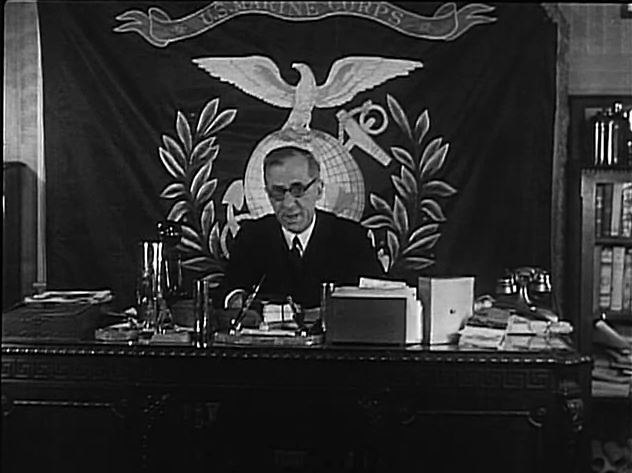
Smedley Butler exposing the Business Plot

Butler immediately notified the government of the plot. Congress held hearings on it. The documents were sealed until only recently, some deleted (but inadvertently exposed and then published). You can read everything here. Congress found the plot to be “alarmingly true.” The committee declared it “received evidence showing that certain persons had made an attempt to establish a fascist organization in this country. There is no question that these attempts were discussed, were planned, and might have been placed in execution when and if the financial backers deemed it expedient.”

None of the alleged plotters were questioned by Congress (claiming it had no reason to based on “hearsay”), nor anybody formally charged. As the plot was uncovered while in the planning stage, it is difficult to say whether it might have gone from discussion to action. The press and numerous politicians considered it a “cocktail putsch,” something discussed but never seriously acted upon, though there was evidence it was actively being plotted. In 1936, William Dodd, the U.S. ambassador to Germany, which at the time was under Nazi rule, wrote a letter to FDR that stated: “A clique of U.S. industrialists is hell-bent to bring a fascist state to supplant our democratic government and is working closely with the fascist regime in Germany and Italy. I have had plenty of opportunity in my post in Berlin to witness how close some of our American ruling families are to the Nazi regime… A prominent executive of one of the largest corporations told me point blank that he would be ready to take definite action to bring fascism into America if President Roosevelt continued his progressive policies.”

The Congressional committee would go on to become the House Committee on Un-American Activities, which later would not afford the same courtesy to suspected communists as it did to the Wall Street and corporate tycoons. Smedley Butler, meanwhile, would go on to pen his famous speech/short book, WAR IS A RACKET, in 1935.

Filed Under: Politics, Submarines & WW2, The Blog

A NIGHT AT THE GARDEN

October 31, 2017 by Craig DiLouie Leave a Comment

night at the garden

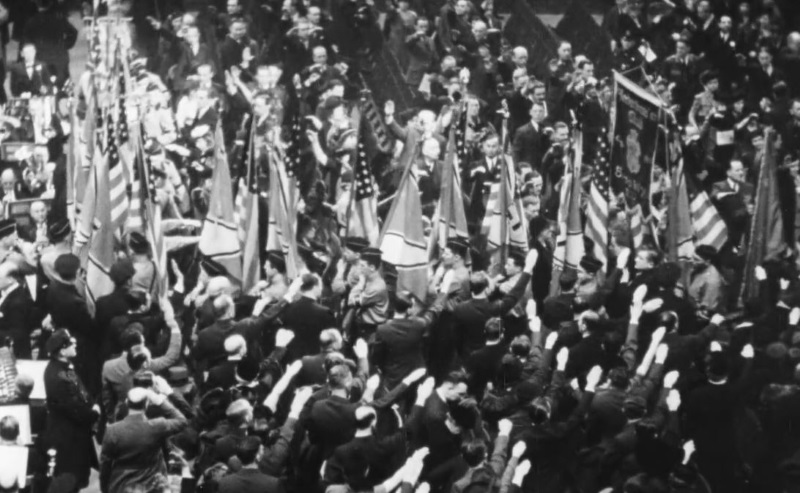
As today is Halloween, I’d like to share with you something I watched that I found truly chilling. Marshall Curry’s powerful documentary, A NIGHT AT THE GARDEN, is just six minutes long. The film depicts a real event that happened in American history, a rally of 20,000 American fascists at Madison Square Garden in New York City on the eve of World War 2.

They were members of the Bund (“federation”), a fascist organization wrapped in the American flag. The main speaker is German immigrant Fritz Kuhn, who demands “our government shall be returned to the American people who founded it” in front of a massive painting of George Washington in the backdrop. The Americans give him the fascist salute. At the end, a woman sings “The Star Spangled Banner.”

When a protester rushes the stage, he’s beaten by brownshirts until police come and take him away, an incident that draws cheers from the crowd. Outside, protesters were being beaten and trampled by police.

Dorothy Thompson, a journalist married to Sinclair Lewis (who would write IT CAN’T HAPPEN HERE), observed the rally. She wrote an article in the August 1941 issue of HARPERS, “Who Goes Nazi?”, in which she proposes a party game of guessing, among guests at a party, who would support the Nazis if they took over. She proposes that Nazism is not so much an ideology as a worldview that appeals to a certain psychology.

While this rally took place, Hitler was building his sixth concentration camp. Seven months later, World War 2 began.

Watch it here:

Filed Under: Politics, Submarines & WW2, The Blog

  • « Previous Page
  • 1
  • …
  • 10
  • 11
  • 12
  • 13
  • 14
  • …
  • 21
  • Next Page »

Categories

  • APOCALYPTIC/HORROR
    • Apocalyptic
    • Art
    • Film Shorts/TV
    • Movies
    • Music Videos
    • Reviews of Other Books
    • Weird/Funny
    • Zombies
  • COMICS
    • Comic Books
  • CRAIG'S WORK
    • Armor Series
    • Aviator Series
    • Castles in the Sky
    • Crash Dive Series
    • Djinn
    • Episode Thirteen
    • Hell's Eden
    • How to Make a Horror Movie and Survive
    • My Ex, The Antichrist
    • One of Us
    • Our War
    • Q.R.F.
    • Strike
    • Suffer the Children
    • The Alchemists
    • The Children of Red Peak
    • The End of the Road
    • The Final Cut
    • The Front
    • The Infection
    • The Killing Floor
    • The Retreat Series
    • The Summer Fun Massacre
    • The Thin White Line
    • Tooth and Nail
  • GAMES
    • Video & Board Games
  • HISTORY
    • Other History
    • Submarines & WW2
  • MEDIA YOU MIGHT LIKE
    • Books
    • Film Shorts
    • Interesting Art
    • Movies & TV
    • Music
  • POLITICAL
    • Politics
  • SCIENCE
    • Cool Science
  • The Blog
  • WRITING LIFE
    • Craig at Work
    • Interviews with Craig
    • Reader Mail
    • Writing/Publishing

Copyright © 2026 · Author Pro Theme on Genesis Framework · WordPress · Log in