Author of adventure/thriller and horror fiction

  • Home
  • The Blog
  • Email List/Contact
  • Interviews
  • Apocalyptic
  • Horror
  • Military Thriller
  • Sci-fi/Fantasy
  • All books

Orbit to Release My Next Novel

May 25, 2017 by Craig DiLouie Leave a Comment

orbitI’m very excited to announce Orbit will publish my next novel, ONE OF US.

ONE OF US is a Southern Gothic literary dark fantasy. In the 1970s, a disease produces a generation of monsters that 14 years later are living in rundown orphanages in the rural South. As the plague generation grows up poor and oppressed, its children begin to develop extraordinary abilities that allow them to rebel and claim their birthright. The novel delves into themes of prejudice, generational conflict, and what makes a monster a monster. Written in the Southern Gothic style, it features elements such as complex characters, rural decay, and the grotesque. Picture TO KILL A MOCKINGBIRD with monsters.

Publishing about 60 titles each year, Orbit U.S. is the sci-fi/fantasy imprint at Hachette Book Group U.S.A., with authors including M.R. Carey, Joe Abercrombie and Iain M. Banks. Plans for ONE OF US are still preliminary, but the intent right now is to publish it in hardcover, likely in 2018, and then trade paperback. It’s the biggest deal I’ve ever gotten for a published work, and I couldn’t be happier to work with a quality company like Orbit.
Filed Under: Apocalyptic, Books, Craig at Work, One of Us, The Blog

Back from Stokercon ’17

May 2, 2017 by Craig DiLouie Leave a Comment

A Mecca for horror writers, Stokercon 2017 proved another great event this year. Had a fantastic time talking shop and otherwise partying and hanging out with great people.

stokercon

Filed Under: Craig at Work, The Blog

My Interview on Spilling Ink

November 23, 2016 by Craig DiLouie Leave a Comment

I recently had the pleasure of being interviewed on the Spilling Ink podcast along with author D.L. Young, author of the DARK REPUBLIC series. The show is hosted by Katie Salidas and David Jones. We rapped indie publishing, beta reading, dime novels, works in progress, and more.

Check it out here:

Filed Under: Craig at Work, Interviews with Craig, The Blog, Writing/Publishing

47 Tips for Effective Dialogue (Part 2)

September 15, 2016 by Craig DiLouie Leave a Comment

At the When Words Collide writing conference in Calgary in August, I gave a fast-paced one-hour presentation on dialogue.

Originally, it was supposed to cover 10 tips for effective dialogue, but that wasn’t good enough.

In the end, I provided 47 tips.

I’m happy to share these tips in a series of blog posts. Part 1 covered 29 tips. Part 2 covers 18 tips.

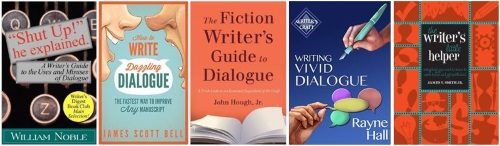
A number of sources informed this presentation, but the primary ones are shown here. All are worth reading.

dialogue1

Tip #30: “Never use a verb other than ‘said’ to carry dialogue,” Elmore Leonard said.

“____,” she said.
“___,” she said, “___.”
She said, “____.”
She said: “_____.”

Do you agree with Leonard? I don’t. I think you should use “said” wherever possible and introduce other tags if they make sense and convey meaning.

Which brings me to:

Tip #31: Other tags can be used for emphasis, exaggeration or to add a little variety.

“____,” he commanded.
“___,” he hissed, “___.”
He cried, “____.”
He roared: “_____.”

Tip #32: Avoid overused and complicated tags.

Minimize overused tags such as “sighed.”

Minimize complicated tags such as “expostulated.”

“Asked” may be redundant if used with “?”

“Hissed” works best if there’s an “s” sound in the dialogue.

Avoid using actions such as “laughed” and “smiled” as tags unless you really, really need it.

Tip #33: Use as few tags as possible.

We don’t want this:

“___,” Jane said.

“___,” John said.

“___,” Jane said.

“___,” John said.

“___,” Jane said.

“___,” John said.

Tip #34: If a tag follows dialogue, close with a comma (inside end quote), otherwise a period, exclamation point or ellipse (declarative).

“Yes,” she said.

“Yes.”

“Yes…”

Close with question mark (or ellipse plus question mark) if interrogative.

Tip #35: Replace tags with dialogue beats—action, facial expression, tone of voice.

If a character does something in the same paragraph as dialogue, no tag is needed.

She pumped her fist. “Yes!”

She smiled. “Yes.”

Her voice rose an octave. “Yes!”

Tip #36: Stage direction (like tags) can provide a short pause but with more drama.

A: “I’m going to finish this beer. Then I’m going to kill you.”

B: “I’m going to finish this beer.” He pulled a knife from his boot and set it on the table. “Then I’m going to kill you.”

Both work, but the second edges up the tension.

Tip #37: Body language is a form of dialogue that can be used for dialogue beats.

#1:

“Jane?”

She frowned and turned away.

#2:

“Jane?”

Her eyes seemed to dance. “What?”

Tip #38: Body language comes from feelings and personality.

dialogue4

Books like the emotional thesaurus can be a useful resource.

Tip #39: Body language reinforces or belies dialogue.

Two examples below. The first reinforces, the second belies.

He pounded his fist against the table. “No more of this!”

He grimaced. “Happy to do it, honey.”

Tip #40: Avoid overused actions in final draft.

I say final draft because in the first, writers often use crutches to keep writing at a brisk pace.

Examples: sigh, shrug, nod, turn, look, pause.

Use software to generate frequency of repeat words (Scrivener, Autocrit.com, HemingwayApp.com, etc.).

Also ensure actions fit character. Would an optimist sigh? A decisive person shrug?

Tip #41: Dialogue can convey facial expression based on context.

While body language can enhance dialogue, dialogue also conveys body language, so you have two tools to work with. Of course, this is based on context.

“I despise you,” she said.

(We can “hear” the glare.)

“So, you want to come upstairs for a drink?” she said.

(We can “hear” her playful smile.)

Tip #42: “Never use an adverb to modify the verb ‘said.’” –Elmore Leonard.

Do you agree with Leonard? I don’t.

But again, be as sparing as possible. I recommend writing with adverbs and then do a search for “ly.” At each instance, take the word out. If the sentence works just as well without the adverb, leave it out. Otherwise, put it back in.

Tip #43: Use adverbs to convey rather than reinforce meaning.

Right:

“I love you,” he said dully.

Wrong:

“Help me,” she said beseechingly.

Alternate to using “dully”:

“I love you.” He said it with all the enthusiasm of noting the time.

Tip #44: Start a new paragraph when a new person is talking. If character does an action, put it in the same paragraph.

“Let’s go,” she said.

He glanced up from his book. “I’m reading.”

“No, you’re not.”

He said, “I was.”

She raised the gun. “Well, you’re not anymore.”

Tip #45: Italics can change the meaning and tone of a sentence. (Be sparing.)

A: “I’m not going,” he said. (“I’m not going.”)

B: “I’m not going,” he said. (“I’m not going, but maybe somebody else it.”

C: “I’m not going,” he said. (“Even if you threaten to kill me.”)

D: “I’m not going.” (Total emphasis.)

Italics and devices like capitals are like camera zooms. They call attention to themselves. Be absolutely sparing, or go all out for effect.

Tip #46: Watch your “!”

“Keep your exclamation points under control. You are allowed no more than 2 or 3 per 100,000 words of prose.” –Elmore Leonard

“An exclamation point is like laughing at your own joke.” –F. Scott Fitzgerald

“Whatever!” –Craig

Write your story with “!” Find the “!” Take it out. If it works without it, leave it out.

Tip #47: Quotation marks are optional but safer.

A lack of quotation marks is common in Southern Gothic (see Cormac McCarthy). In Cold Mountain, Charles Frazier uses a dash preceding dialogue.

If you break convention, intention and confidence are required. Note anytime you do something different, there are risks.

You can experiment, such as taking out quotation marks in flashbacks.

THANKS FOR LISTENING

That concludes “47 Tips for Effective Dialogue.” I hope you learned something. I certainly did writing it.

Click here to download a PDF of the presentation I gave at When Words Collide.

Filed Under: Craig at Work, The Blog, Writing/Publishing

47 Tips for Effective Dialogue (Part 1)

September 14, 2016 by Craig DiLouie Leave a Comment

At the When Words Collide writing conference in Calgary in August, I gave a fast-paced one-hour presentation on dialogue.

Originally, it was supposed to cover 10 tips for effective dialogue, but that wasn’t good enough.

In the end, I provided 47 tips.

I’m happy to share these tips in a series of blog posts. Part 1 covers 29 tips.

A number of sources informed this presentation, but the primary ones are shown here. All are worth reading.

dialogue1

TIP #1: Learn these tips, then break them at will.

There are no sacred cows. Just be aware that if you break with best practice, you are doing so intentionally for effect.

Tip #2: According to James Scott Bell (How to Write Effective Dialogue), every piece of dialogue must do one of these:

Set the tone
Set the scene
Reveal character
Reveal story information
Reveal theme

 SET THE TONE

Tip #3: Dialogue should enhance the tone of the story.

Consider the following piece of exposition with two dialogue options. Which would work better for a horror story?

The grinning ghost lurched down the stairs in a series of horrific freeze frames.

Option A: “Murder,” John murmured. “Bloody, rank death is coming for us.”

Option B: “Pretty neat,” John exclaimed, “but we’d better make tracks before that ghost pulls a number on us.”

Option A would obviously work better. It’s a bit pulpy, but it enhances the atmosphere.

Tip #4: Dialogue should sound natural without being real.

Real talk is boring.

“But that’s the way people talk! But that’s what somebody I know actually said! But this really happened!”

Yeah, and it’s boring.

John Hough, Jr., author of The Fiction Writer’s Guide to Dialogue, says, “Your characters have to respond immediately, but you have all the time in the world to craft that response.”

Use that time to ensure every bit of dialogue movies the story forward.

Tip #5: Dialogue should be well-crafted but sound natural.

If it’s too real, it’s boring.

If it’s too perfect, it doesn’t sound real.

Tip #6: Read your dialogue aloud to see how it sounds to the ear.

In fact, it’s recommended to read your entire book aloud.

Tip #7: Shorter is better.

Favor short sentences. Shorter than narration. Sentence fragments are okay. Shorter feels real, while enhancing readability.

Same with paragraphs. Shorter is better. Hough recommends 1-3 sentences max, preferably 1-2).

Use contractions. That’s how people talk. For halting speech, use an ellipse.

Characters can interrupt each other when needed.

Tip #8: Avoid name-calling, repetition and the tics of real speech.

Avoid overusing characters saying each other’s name. People don’t say, how are you, John. That’s great to hear, John. What are you doing today, John. Use names only to get attention and focus emphasis.

Avoid repetition unless to drive a point home.

Avoid tics of real speech such as hello, goodbye, um, ah, huh, how are you, etc., unless it is shaded with meaning.

SET THE SCENE

Tip #9: Avoid “talking heads in white space.”

Talking heads: Long stretches of dialogue.

White space: No clear scene.

Dialogue needs context.

Tip #10: To address “talking heads,” have the characters do something while they talk.

dialogue2

Tip #11: To address “white space,” set the scene.

This can be broad-stroked if the scene was set earlier.

You can provide an upfront description or sprinkle details throughout the dialogue.

Tip #12: You can start a story with dialogue without setting the scene if there’s action too.

Use beats, not tags, here. A beat is a bit of action (e.g., “He looked up from his computer.”) A tag is a dialogue tag (e.g., “she said”).

Avoid info dumps. Keep it moving.

Establish the point of view early.

Limit the conversation to two characters.

Here’s an example:

“Help!”

“It’s so dark. Where are you?”

John clung to the ledge. “Help!”

“I see you,” Jane said. “Hang on!”

“I don’t…”

She reached for him, missed. “Damn it!”

“I don’t think I can–”

“Hang on, John!”

He felt his grip slipping. “Jane? Oh, God. Jane!”

As he began to fall, her hand clamped over his wrist and pulled.

Tip #13:Use dialogue to set the scene directly.

Example 1:

“God, that water,” Jane said. “Reminds me of the turquoise ring I lost in Cuba.”

John said, “I can see right to the bottom. The pirate ship—it’s down there!”

Example 2:

“The desert just goes on and on,” John moaned. “But that shimmer…”

“Mirage,” Jane said. “It’s not what you want it to be.”

REVEAL CHARACTER

Tip #14: Dialogue should reflect an appropriate quality of voice.

In Writer’s Little Helper, James V. Smith, Jr. identifies five qualities of voice:

Vocabulary: general level, distinctive phrases/words (signatures for character)

Verbosity: length of speech

Velocity: pace and rhythm

Viewpoint: point of view (story), point of view (character’s worldview)

Venom: emotional intensity

Tip #15: Reveal character and move the story through conflicting goals or agendas.

A very important tip, this one. People talk in books to push their agenda. For everything they say, there must be a reason.

The conflict can be expressed outright or as a subterfuge.

Consider the below example. In this snatch of dialogue, Jane wants John, who is severely ill, to get out of the house and live his life to the fullest. Depressed, John wants to mope.

“It’s a beautiful day,” Jane said.

He shrugged. “It’s a day.”

Here’s another example: John wants to sleep. Jane wants tell him about a self-help book she’s reading about how to stick up for yourself. At end, the combination of the book and his refusal to engage might spark a decision to leave him on the spot.

Tip #16: Consider psychology when writing dialogue.

For example, transaction analysis can help develop characters and dialogue. This is a theory (Games People Play by Dr. Eric Bene) that people interact based on a self-perceived role in a conversation. Jack Bickham, author of Writing Fiction that Sells (1989), first described it as a potential dialogue tool. Dr. Bene identifies three self-perceived roles in conversation.

Parent: authority, decisive, power

Adult: even-handed, analytical, calm

Child: emotional, selfish, irrational

You can write miles of dialogue off different combinations of these roles.

Tip #17: Consider conflict has shades.

James V. Smith identifies six types of conflict:

Overt aggressive: threats of violence

Passive aggressive: apparently submissive character spars with stronger one

Provocation: taunt or dare

Undercurrent: conflict is suggested but not open

Ambiguity: like undercurrent but more subtle, only writer knows for sure if conflict is there

Subliminal: conversation about one thing but heading to conflict

Tip #18: Raise the conflict level by keeping it short and simple.

This reinforces Tip #7.

To raise the level of conflict in dialogue, favor short, clipped Anglo-Saxon words (e.g., “box” instead of “container”), short sentences, short paragraphs. Repetition can add emphasis. Be declarative (“I do,” not “I think I do”).

Tip #19: Besides conflicting agendas, how characters communicate can enhance interest and conflict.

Below is a number of ways to accomplish this.

Turn statements into questions:

A: “You haven’t left the house in days.”

B: “When’s the last time you left the house?”

Withhold the answer:

Q: “When’s the last time you left the house?”

A: “I have everything I need right here.”

Evade, ignore, misdirect, Q with Q:

Q: “When’s the last time you left the house?”

A: “Do we have to talk about this right now?”

Misunderstanding:

John: “How are you?”

Jane: “What?”

John: “How are you?”

Jane: “I can’t hear you over the music.”

Indirect discourse:

John: “How are you?”

Jane: “Look at them over there. So happy.”

Sucker punch:

John: “How are you?”

Jane: “Mind your own business.”

Interruption:

John: “Will you marry me, Jane?”

Jane: “John! I don’t know what to say—”

Man: “Down on the floor! This is a robbery!”

What/Why:

John: “Did you kill him?”

Jane: “He just wouldn’t shut his mouth.”

Replying to perceived real question:

John: “So you can’t account for your whereabouts that night.”

Jane: “I didn’t kill him. I loved him.

Tip #20: Reveal character through sharp, colorful dialogue.

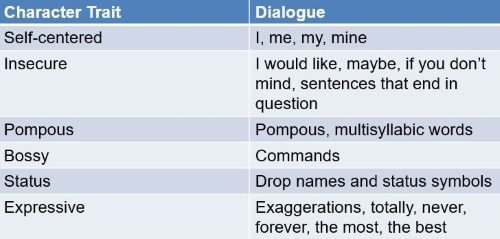
Give each character a unique voice. Zingers (snappy comebacks), for example, make a character seem superior and likeable. Reflect on a primary trait or goal (angry, bitter, outgoing, cynical, etc.)

dialogue3

This can be particularly useful for making otherwise flat secondary characters more colorful.

Tip #21: Gender-specific speech is possible, but tread carefully.

Good luck getting this right in your book.

Tip #22: Be very economical with insults and foul language.

Use when needed for specific effect. Don’t force it for color. A little goes a long way.

In my submarine series Crash Dive, the submariners swear hugely. But I still keep it sparing.

You can invent bad words. “Frak” is a famous example from Battlestar Galactica. In my Renaissance fantasy novel The Alchemists, the characters are Europeans, so when they swear, they do so in their native language. One character, a scientist, swears using the names of philosophers (e.g., “Occam’s Razor!”).

Tip #23: What a character doesn’t say can be meaningful.

Tip #24: Reveal character with internal dialogue.

This naturally applies only to a point-of-view character. Deep point of view can blend external and internal dialogue in the same tense. The dialogue must be honest and revealing.

Internal dialogue can slow the story’s pace if that’s acceptable or needed.

You don’t need quotes or tags when doing internal monologue. Example:

Mom called me. “What now?” I wondered.

becomes:

Mom called me. What now?

REVEAL STORY INFORMATION

Tip #25: Save info dumps for big reveals laced with emotion.

Better to spread out, here and there if just basic info or to flavor the story.

For example, in a fantasy story featuring dragons, instead of giving a history of dragons, reference them in narration and dialogue:

His daughter held up a dragon’s tooth. “Look what I found at the market today!”

John, who was old enough to remember the dragons, shivered and forced a smile. “That’s a great find, sweetie.”

Tip #26: Avoid exposition in dialogue.

Particularly what characters already know or info that shows too great an awareness of the story. That’s when the author reveals himself or herself through the character, a big no-no.

That being said, you can do more telling in dialogue than you should in narrative.

“Mom’s not here?”

“She went to work at 7AM.”

(Mom has a job, so presumably works every day. We don’t seem to need the 7AM. But…)

“Why so early?

(Ah, now the 7AM works. Context is vital.)

Which brings us to:

Tip #27: “Make sure your characters are speaking to each other, not to the reader.” -John Hough, Jr.

REVEAL THEME

Tip #28: Dialogue is the only place in the book the author can talk about theme.

Postulate a theme, come up with an opposing view, and have two characters duke it out. After this scene, any arguing can simply be because they don’t like each other.

Tip #29: How to have an argument:

Use strong verb tags and beats and short tight sentences. Overall, it should be succinct. If one character tries to get long-winded, it’s okay for the other to interrupt.

Questions/sentences can repeat but with different replies

THANKS FOR LISTENING

That’s it for today! In my next blog post, I’ll provide a series of tips related to technique.

Click here to download a PDF of the presentation I gave at When Words Collide.

Filed Under: Craig at Work, The Blog, Writing/Publishing

Tips for Writing Effective Dialogue

August 8, 2016 by Craig DiLouie 2 Comments

dialogue

At the When Words Collide writing convention in Calgary this weekend, I’ll be giving a one-hour talk presenting 45 tips for writing effective dialogue, distilled from more than a dozen sources. The talk takes place Saturday, August 12 at 12 noon in the Fairview Room at Delta Calgary South. The con is sold out, but if you’re going, I hope to see you there.

Filed Under: Craig at Work, The Blog

  • « Previous Page
  • 1
  • …
  • 4
  • 5
  • 6
  • 7
  • 8
  • …
  • 13
  • Next Page »

Categories

  • APOCALYPTIC/HORROR
    • Apocalyptic
    • Art
    • Film Shorts/TV
    • Movies
    • Music Videos
    • Reviews of Other Books
    • Weird/Funny
    • Zombies
  • COMICS
    • Comic Books
  • CRAIG'S WORK
    • Armor Series
    • Aviator Series
    • Castles in the Sky
    • Crash Dive Series
    • Djinn
    • Episode Thirteen
    • Hell's Eden
    • How to Make a Horror Movie and Survive
    • My Ex, The Antichrist
    • One of Us
    • Our War
    • Q.R.F.
    • Strike
    • Suffer the Children
    • The Alchemists
    • The Children of Red Peak
    • The End of the Road
    • The Final Cut
    • The Front
    • The Infection
    • The Killing Floor
    • The Retreat Series
    • The Summer Fun Massacre
    • The Thin White Line
    • Tooth and Nail
  • GAMES
    • Video & Board Games
  • HISTORY
    • Other History
    • Submarines & WW2
  • MEDIA YOU MIGHT LIKE
    • Books
    • Film Shorts
    • Interesting Art
    • Movies & TV
    • Music
  • POLITICAL
    • Politics
  • SCIENCE
    • Cool Science
  • The Blog
  • WRITING LIFE
    • Craig at Work
    • Interviews with Craig
    • Reader Mail
    • Writing/Publishing

Copyright © 2026 · Author Pro Theme on Genesis Framework · WordPress · Log in