Author of adventure/thriller and horror fiction

  • Home
  • The Blog
  • Email List/Contact
  • Interviews
  • Apocalyptic
  • Horror
  • Military Thriller
  • Sci-fi/Fantasy
  • All books

MAD MEN

November 22, 2019 by Craig DiLouie Leave a Comment

I was late to the party for MAD MEN, but I’m having fun with it, having just finished season 2. The show at times feels a bit like a soap opera, but overall I’m enjoying this depiction of the birth of advertising and the joys and sorrows of life in the early ’60s.

The show follows Don Draper (the fantastic Jon Hamm), a handsome, confident advertising whiz who works at a prestigious New York advertising agency. He’s the perfect man with the perfect wife, kids, and house in the suburbs. Other characters include his wife, who is suffering from boredom and angst about her security, and various people working at the agency. They live in the early 60s, a relatively utopian era of social order and prosperity, but everything is not as nice as it seems.

I love how the show presents the era from the viewpoint of its conventional wisdom, that everything is perfect, nobody should protest or rock the boat, homosexuality is demonized, women have no real security without men, women take care of house and kids but men call the shots, kids are largely ignored yet expected to behave perfectly, and that real men drink hard, fool around on their wives, compete with each other in an endless alpha male game, and otherwise rule their world. Everybody in the show seems happy with the way things are, not knowing any different; most of the characters are likeable but heavily flawed right to the edge of being detestable, and yet a product of their time. The show then presents the consequences of this society’s norms, letting the viewer judge the era for themselves.

The writing has a good pace with some nice if on-the-nose symbolism, the sets and costumes appear rendered in the era’s technicolor, the acting is strong, and the dialogue is witty. Besides the social commentary–not social commentary, really, but the invitation to the viewer for such–my favorite aspect of the show is seeing the birth of advertising. America enjoyed a healthy middle class at the time, people with money to spend and wanting to have it all, and corporations and their ad agencies delivered not only by providing products and new marvel gadgets, but by defining what a perfect life looked like. Besides an excellent summary of the principles of marketing, the show also presents fantastic commentary about the art of business. Even here, the show presents the consequences of this consumer utopia, showing people gaining a perfect life only to continue aging, feel empty, and suffer the malaise and uncertainty of midlife crisis.

Overall, I’m enjoying MAD MEN as an excellent period drama that captures the zeitgeist of the era, and look forward to continuing on to the next season. However, I don’t recommend it if you’re quitting smoking.

Filed Under: Movies & TV, Other History, The Blog

THE KING (2019)

November 12, 2019 by Craig DiLouie Leave a Comment

Netflix’s THE KING provides a mashup of the historical and Shakespearean Henry IV Part 2 and Henry V with beautiful cinematography, brooding atmosphere, and plenty of medieval grit, but fails to either provide a true biopic or the powerful level of storytelling in its source material. Overall, it’s very enjoyable the way THE OUTLAW KING was, but as with that film, there was a pronounced lack of character development. The result is I was fully immersed in the film while I was watching, but then when it ended I shrugged and mostly forgot about it.

The historical Henry V (king 1413-1422) was the second king of the House of Lancaster, son of Henry IV, who overthrew Richard II to claim the throne. In his youth, he fought the Welsh in a revolt and helped his ailing father rule until political conflict drove them apart. When his father died in 1413, he assumed the crown and pressed his claims in France, leading to a string of victories, most famously Agincourt, when the English longbow and muddy field resulted in the slaughter of the flower of French chivalry. In this, Henry united his kingdom and established it as a major power.

The Shakespearean Henry IV Part 2, we see Henry as Prince Hal, living a life of debauchery with Falstaff as his mentor in the criminal underworld. When his father dies, he transforms into Henry V, a cunning king, having learned about what makes the common people tick. In Henry V, he goes to France and defeats the French host at Agincourt, bolstering his men’s courage with the rousing St. Crispin’s Day speech including the line, “We few, we happy few, we band of brothers.” Thematically, these stories are about growing from a boy to a man, the challenges of rule, and war.

THE KING appears aimed at marrying these two visions buttressed visually by plenty of medieval realism and atmosphere. Stylistically, it succeeds, from the great cinematography to the rich dialogue to the horrific battle itself. The acting is terrific, with Timothée Chalamet (the poor man’s Cillian Murphy) doing a fantastic job as the brooding Henry. There’s a bleakness and loneliness to the overall presentation, which worked for me. Thematically, the story appears to be about ruling wisely, which requires a balancing act between promoting peace while appearing strong, and finding people you can trust to give you honest and wise advice.

I had a number of criticisms of this film, such as Henry undermining his own goals of internal and external peace by murdering enemies (one of them casually) while invading France (nominally to further his father’s goals on the continent), and the way the Battle of Agincourt is presented, though it’s fun to watch. This didn’t hurt my appreciation, though. What did was the same lack of character development that made THE OUTLAW KING similarly a fun spectacle about people I didn’t care about. We never really get a sense of who Henry is, what his flaw or mis-belief is, and how he must change because of the central conflict (he does change, but not much). As with OUTLAW KING, a bride appears, whom the protagonist will treat as an equal, which smacks of pandering to modern sensibilities, as these brides have almost no screen time or influence in their films. As a result of plot taking charge over character, the story feels disjointed as it covers a lot of ground.

Overall, I liked THE KING quite a bit, hope Netflix makes more of these historical epics, and recommend a watch. I just hope in the future the writers take that extra leap and infuse the story engine with deeper, organic characterization to make me care more about what happens in the historical plot.

Filed Under: Movies & TV, Other History, The Blog

LINCOLN (2012)

October 14, 2019 by Craig DiLouie Leave a Comment

Directed by Steven Spielberg but without the usual heavy-handedness, and based on the book TEAM OF RIVALS: THE POLITICAL GENIUS OF ABRAHAM LINCOLN, LINCOLN (2012) is an amazing film about the final four months of the iconic president’s life, emphasizing his efforts to both end the Civil War while getting the thirteenth amendment passed in the House of Representatives. With a star-studded cast led by the great Daniel Day-Lewis, who shreds every scene while embodying the wit, strength, and humanity of Lincoln, this is an amazing film that treats its audience as intelligent adults and presents an insider look at how the institution of slavery legally ended in America for all time.

As I grow older, I find myself fascinated by sociological storytelling, in which a system is the main character, around which we have an ensemble cast of people acting within that system. THE BIG SHORT, GAME OF THRONES, the FOUNDATION series, and THE WIRE are all great examples. These stories don’t have villains so much as different individuals who find themselves in conflict with each other within a particular system. LINCOLN is one such story, as much about a major historical event than Lincoln himself, however instrumental he was in that event. They say lawmaking is similar to sausage making in that you really don’t want to know what goes into the sausage, but in this case, the sausage making makes for tense, fascinating storytelling–and provides a real appreciation for the tightrope Lincoln had to walk between the different factions: Democrats and right-wing, moderate, and left-wing Republicans.

Overall, I highly recommend LINCOLN if you like history, incredible acting and world building, and sociological storytelling.

Filed Under: Movies & TV, Other History, The Blog

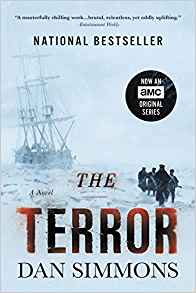
THE TERROR by Dan Simmons

August 26, 2019 by Craig DiLouie Leave a Comment

Dan Simmons’s THE TERROR is a sprawling, ambitious, well-researched, immersive, supernatural horror epic set in the Arctic.

In the 1840s, two British exploring ships probe the Arctic seas, searching for the Northwest Passage that promised a shorter trade route to China and India. After both ships wind up icebound in the harsh winter, the expected summer thaw does not occur. And after a native is accidentally killed on the ice, a deadly, malevolent entity in the form of a giant polar bear begins picking off the terrified crews. The expeditionary force’s captain leads his men on foot in a desperate flight across the ice.

What a brutal book. The entity is very cool, but in the end, fairly unnecessary to the real horror, which was starvation, scurvy, disease, the back-breaking labor of man-hauling heavy sledges across pack ice, and the terrible, terrible cold. In some parts, the constant difficulties of the hostile environment make for suffocating reading. Otherwise, I liked the characters and what drove them, the historical touches, the desperate fight to survive. While THE TERROR is a supernatural horror story, it’s really a survival horror story in its cold heart, a story about good and flawed men fighting to survive to the last sad gasp.

I read the book after watching the TV adaptation, and enjoyed both, though there are some significant differences. The show played the survival horror very well, particularly the idea of Englishmen struggling to do their duty until all notions of honor, country, and morality disintegrate in the face of disease, starvation, and lost hope. The book, meanwhile, did a far better job with the creature, including its explanation, and Captain Crozier’s fate. If you like the basic story, I’d recommend both.

My only criticism of the book is it’s fairly sprawling, and I found myself skimming in quite a few places. Overall, however, THE TERROR is quite a powerful tale both as historical fiction, supernatural horror, and survival horror.

Filed Under: Books, Other History, Reviews of Other Books

THE NORTH WATER by Ian McGuire

July 30, 2019 by Craig DiLouie Leave a Comment

Ian McGuire’s THE NORTH WATER reads a little like Cormac McCarthy, a little like Joseph Conrad, to provide a unique and brutal tale about whaling in the 1800s and the illusion of morality.

The story centers on two men: Henry Drax, a harpooner about to sail with THE VOLUNTEER, a whaling ship, and Patrick Sumner, a disgraced Army surgeon fresh from the Indian Mutiny and looking to escape civilization a while by joining the expedition. Drax lives in the moment and does what he likes, an amoral man committing immoral acts. Sumner means well and believes in humanity’s innate goodness and potential, but is continually suffering the consequences of the ill machinations of men claiming to have good on their side.

The story is simple: THE VOLUNTEER ventures into the Arctic and finds disaster, putting Drax and Sumner on a collision course. The writing is extraordinary, a spare, compelling prose that turns pages, brings the past to life, and elevates the mundane brutality to something like myth. The moral of the story is also simple, revealed in Sumner’s decision to bend morality’s elastic quality to his own benefit and survival, pushed to the point of giving up his illusions.

The tale concludes with less of a bang than one would expect given the long setup, but overall, it’s a powerful ride. I greatly enjoyed it as historical fiction and for its compelling storytelling and themes.

Filed Under: Books, Other History, The Blog

CHERNOBYL (2019)

June 30, 2019 by Craig DiLouie Leave a Comment

The HBO series CHERNOBYL (2019) is without a doubt one of the most gripping and powerful dramas I’ve ever watched on TV. Intelligent, poignant, and horrific, this miniseries provides a fictionalized dramatization of an actual nuclear disaster in the Soviet Union in the 1980s, which came close to devastating an entire continent.

The show gets very quickly to the accident, which is horrifying itself because we, the viewers, know how dangerous radiation is and that there was a catastrophic explosion exposing the core to open air, while some of the characters don’t, either through ignorance or willfully ignoring the truth. The show frequently revisits this horror as we learn of the incompetence, lies, and brutality of the system that contributed to the accident while covering it up, and as various characters learn they have very little time left before they die a painful death.

As news of the disaster works its way up the Soviet bureaucracy, Valery Legasov (the fantastic Jared Harris giving the usual master class on acting), a nuclear scientist, is brought in to help Boris Scherbina (the always solid Stellan Skarsgård), a bureaucrat tasked with fixing the mess while safeguarding the interests of the State. At first, they hate each other, but a respect forms as Boris comes to understand the severity of the situation and that nothing else matters other than solving it.

The problem is eventually solved for the most part, but it’s only through the heroism of thousands of workers, soldiers, and scientists who flock to Chernobyl to help. These are truly shining moments among the horror and bureaucratic stupidity, where average people sacrifice themselves and/or tell the State to go to hell. Either because what needs doing is too important, or because they’ve been exposed to radiation and know they’re already dead. The show ends on this odd and poignant juxtaposition between disgust with human stupidity and hope in human heroism and compassion, combined with condemnation of the lies that go hand in hand with national exceptionalism.

Overall, CHERNOBYL is powerful, gripping, smart, interesting–a brilliant example of TV done right.

Filed Under: Apocalyptic, Movies & TV, Other History, The Blog

  • « Previous Page
  • 1
  • …
  • 3
  • 4
  • 5
  • 6
  • 7
  • …
  • 11
  • Next Page »

Categories

  • APOCALYPTIC/HORROR
    • Apocalyptic
    • Art
    • Film Shorts/TV
    • Movies
    • Music Videos
    • Reviews of Other Books
    • Weird/Funny
    • Zombies
  • COMICS
    • Comic Books
  • CRAIG'S WORK
    • Armor Series
    • Aviator Series
    • Castles in the Sky
    • Crash Dive Series
    • Dien Bien Phu
    • Djinn
    • Episode Thirteen
    • Hell's Eden
    • How to Make a Horror Movie and Survive
    • My Ex, The Antichrist
    • One of Us
    • Our War
    • Q.R.F.
    • Strike
    • Suffer the Children
    • The Alchemists
    • The Children of Red Peak
    • The End of the Road
    • The Final Cut
    • The Front
    • The Infection
    • The Killing Floor
    • The Retreat Series
    • The Summer Fun Massacre (Slasher Season, Book 1)
    • The Thin White Line
    • The Yule Day Slaughter (Slasher Season, Book 2)
    • Tooth and Nail
  • GAMES
    • Video & Board Games
  • HISTORY
    • Other History
    • Submarines & WW2
  • MEDIA YOU MIGHT LIKE
    • Books
    • Film Shorts
    • Interesting Art
    • Movies & TV
    • Music
  • POLITICAL
    • Politics
  • SCIENCE
    • Cool Science
  • The Blog
  • WRITING LIFE
    • Craig at Work
    • Interviews with Craig
    • Reader Mail
    • Writing/Publishing

Copyright © 2026 · Author Pro Theme on Genesis Framework · WordPress · Log in

imunify-bot-check